Packaging Is Part of the Product Specification
For an importer, the mirror is not finished when it passes a factory check. It must survive handling, consolidation, international transport, warehouse movement and the final trip to a job site or customer. Packaging therefore belongs in the purchase specification and sample approval, not in a vague note that says “export carton.”
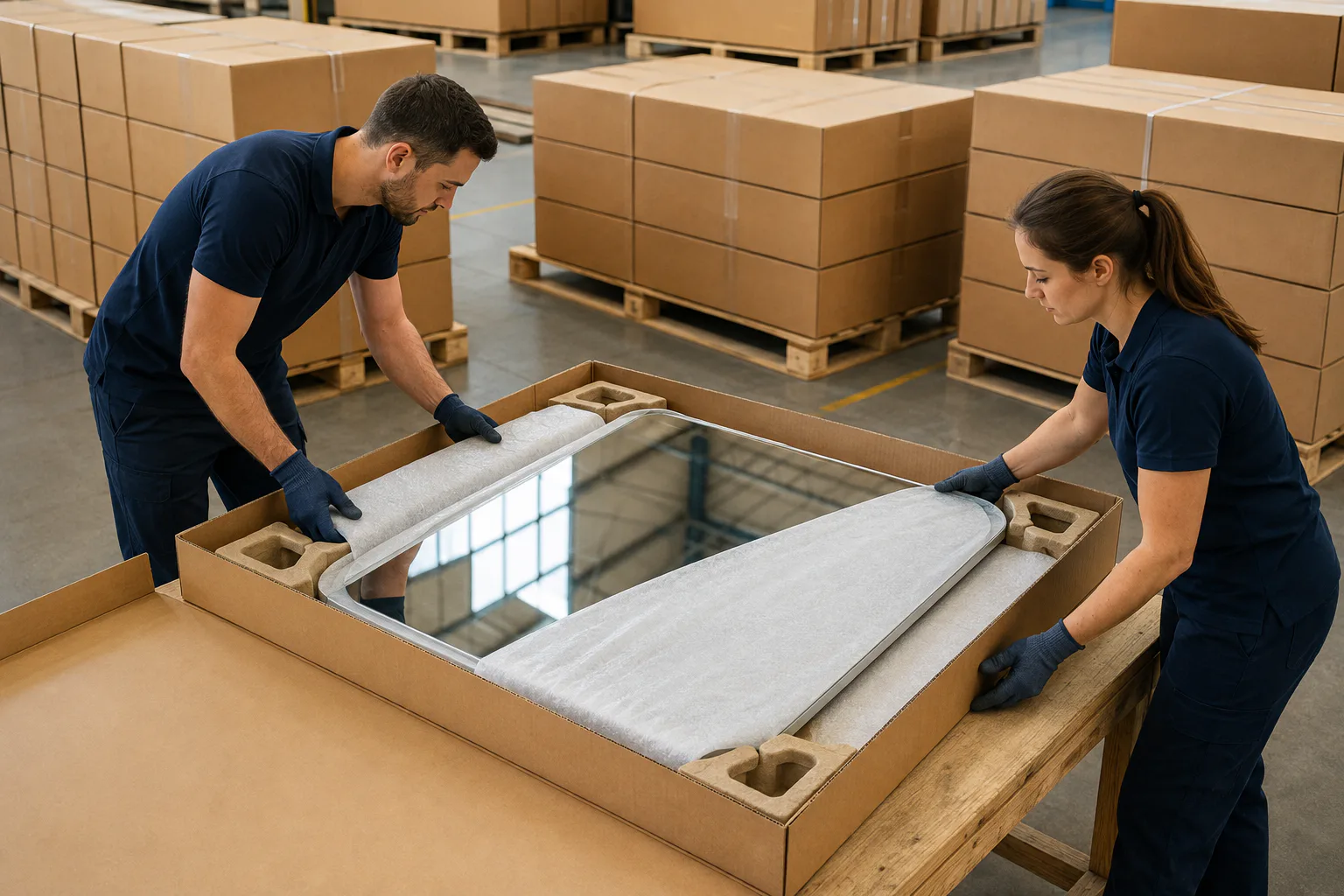
Ask for photographs or a packing diagram that identifies the protective sleeve, edge and corner protection, internal clearance, carton construction and any outer reinforcement. The goal is to understand how movement and concentrated impact are controlled without making unsupported assumptions from carton thickness alone.
Check the Complete Packed Unit
Review the packed sample in the same orientation and with the same accessories planned for production. Loose hardware should be contained so it cannot move across the mirror surface or damage rear components. Any instructions, fittings or separate parts should have a fixed location that warehouse staff can verify.
Record the gross dimensions and weight of the packed unit. These figures affect pallet design, warehouse slots, local delivery and freight estimates. If several mirror sizes share one order, request a packing list that separates each carton type instead of providing only an average.
Plan Pallets and Mixed Loads on Paper
A carton that works alone may perform poorly when stacked or mixed with different shapes. Ask how cartons are oriented, restrained and separated on the pallet, and where heavier units are placed. Round, pill and rectangular mirrors can create different carton footprints, so a mixed order needs a loading plan rather than a simple carton count.
Confirm whether pallets are required by the destination warehouse and whether there are height, weight or material restrictions. These are buyer-side logistics facts that should be shared before the final packing plan is approved.
Make Shipping Marks Useful
The outer carton should help people identify and handle the correct unit without opening it. Agree the model reference, size, quantity, orientation or handling symbols and any buyer-required purchase-order information. Keep the label readable and consistent; too many competing marks can be as confusing as too few.
If private labeling is involved, approve a label proof separately from the product sample. Never assume that a logo file sent months earlier is still the correct version. The final production record should connect the carton label to the model and packing list.
Prepare the Arrival Inspection Before Shipment
Tell the receiving team what to photograph: pallet condition, carton faces, any impact points, the label and the product after opening. Establish a sampling plan appropriate to the order and a process for isolating questionable cartons. Clear records make it possible to distinguish isolated handling damage from a repeated packing issue.
When requesting prices for LED bathroom mirrors, include the destination, preferred shipment method, warehouse constraints and model mix. A useful quotation should allow space for a packaging conversation, because the lowest unit price has little value if the mirrors do not arrive ready to sell or install.